Pen Paste & Plain Speaking: Patrick McGuigan On Cheese
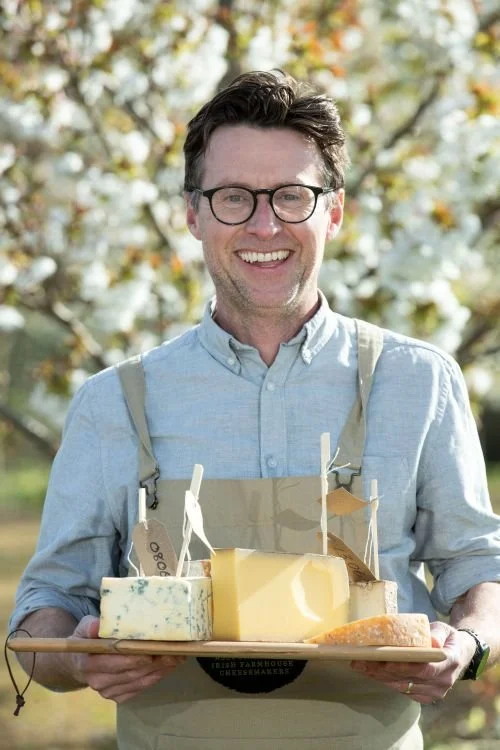
Patrick McGuigan - Photo Credit Finbarr O’Rourke
It was mid-December when I interviewed Patrick. The kind of week where every cheesemonger is either already knackered or pretending they’re not. Patrick is winding down for Christmas (in theory), whilst as a cheesemonger I am up to my eyeballs in Stilton (in reality), and we’re both very aware that “busy” has changed shape in the last couple of years. People hold their nerve longer now. Budgets are tighter. The last week or two before Christmas is where it all kicks off. And in that squeeze, “high value cheese” can feel like a luxury people talk themselves out of.
Which is exactly why I wanted this conversation.
Patrick’s been writing about cheese for close to two decades. He’s a World Cheese Awards judge. He’s got that rare journalist’s gift: he can celebrate the joy of cheese without losing sight of the tension underneath it. And he’s just co-written a new book with Carlos Yescas, One Cheese to Rule Them All, a title that’s playful on the surface, but actually points straight to the big question at the heart of modern cheese.
Is there such a thing as “the best cheese”?
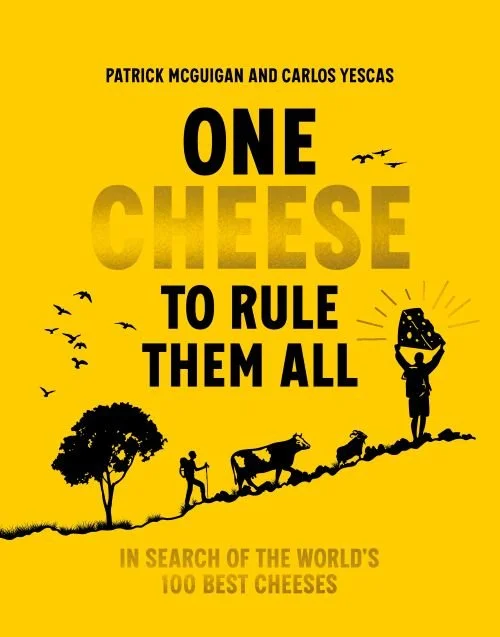
Order via Murdoch Books
Two journeys, one book, and a decade of judging
Patrick and Carlos met the way a lot of genuine cheese friendships begin: judging together, year after year, at the World Cheese Awards. More than a decade of tasting, arguing (the good kind), laughing, and learning. The spark for the book came from Carlos, but the premise landed because they both knew the World Cheese Awards isn’t just a competition, it’s a global festival of cheese.
And the partnership makes sense. Patrick brings UK and European depth, plus that sharp editorial instinct. Carlos brings deep global cheese culture from Mexico, the US, Latin America and a wider social lens. Between them, they could build something that isn’t a textbook, and isn’t a glossy “top 10” list either.
Patrick put it best: they wanted the book to work on multiple levels.
You can flick through it like a reference “I like Camembert, tell me something I didn’t know.”
You can read it like a travel log, people, places, landscapes, the sense of why a cheese tastes like where it’s from.
And then there’s the deeper thread: what actually makes a great cheese, and why do certain cheeses keep winning?
The pattern they couldn’t ignore: pasture, people, and proper craft
As they worked through 100 cheeses, a theme kept reappearing. The best cheeses so often come from smaller producers with their own animals. Often raw milk. Good welfare. Traditional skills. A closeness to land and season that doesn’t come from branding, it comes from reality.
That landed hard for me, because it mirrors what I see every week. The cheesemakers who are most connected to their animals and their land often aren’t just producing better cheese, they’re often the most grounded people in the room. There’s a clarity to what they’re doing.
I mentioned Stonebeck and the Hattons in our chat as the kind of producers who prove the point. Yes, they charge a price that can make people pause, but the price is sane when you understand what they’re trying to do. I feel the same about the work of people like Jonathan Crump: when you taste those cheeses, you’re tasting decisions. Farming decisions. Time decisions. Skill decisions. And you can’t fake that.
Writing a book about 100 cheeses without repeating yourself
Here’s the tricky bit: if you’re writing about 100 cheeses and you care about raw milk, regenerative farming, and craft, you could easily end up writing the same paragraph 100 times.
Patrick was honest about that. He and Carlos had to challenge each other constantly: why this cheese? What’s the angle? What story does it unlock?
That’s the journalist’s instinct Patrick talks about, the “what’s the story?” reflex. The story is never “a new cheese exists.” The story is the grandfather who taught the maker. The new system nobody else is using. The economics that don’t add up. The religion, the history, the politics, the culture, the human stuff. Cheese is the entry point.
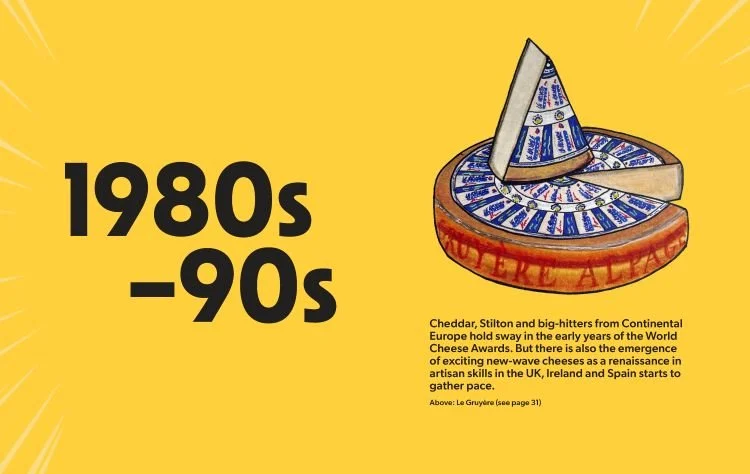
They also used World Cheese Awards data as a spine: decades of results, patterns, repeat winners, surprises. It forced them to include cheeses that are simply impossible to ignore (Gruyère, for example), and it highlighted cheeses that many of us in the UK don’t see often, like Bergkäse from Austria, yet it keeps winning, year after year. That’s not hype. That’s evidence.
The conversation Patrick wants cheese to have: sustainability isn’t just carbon, it’s cashflow
When I asked Patrick what he hoped the book could change, one conversation among makers, judges and eaters, he went straight to something we avoid because it’s uncomfortable:
Cheese has become big business. Production has homogenised. Diversity is at risk. And without diversity, food becomes boring.
But his bigger worry wasn’t only environmental sustainability. It was economic sustainability. The viability of small producers. The truth that the romantic story can be a trap: long days, seven-day weeks, early mornings, tiny margins, and not much money.
Patrick shared a moment that changed him early on: interviewing a maker who walked away from a beautiful raw goat’s cheese after about ten years because the maths didn’t work. Another was the emotion of seeing traditional mountain production, Beaufort and Etivaz made in conditions that could have been 500 years ago, and feeling the wonder of it alongside the brutal question: how does anyone make a living like this?
This is where the conversation got properly real.
Because in the middle of a cost of living crisis, telling people to “just pay more” can sound naive. And yet: if we want these cheeses to exist in ten years, that’s where we end up. The price has to reflect reality. Not “artisan” as a marketing word, just real food priced as real food.
Patrick made a point that stuck: people will balk at paying for cheese, then spend the same money next door on a couple of coffees without thinking. The issue isn’t always absence of disposable income, it’s what we’ve been trained to value.
Less preaching. More progress.
Then came one of my favourite moments: Patrick explained why he insisted on including Wensleydale with cranberries in a book that otherwise celebrates elite, award-winning cheese.
Carlos questioned it. Patrick held the line.
Because we’ve got to stop preaching at people.
He wasn’t saying mass production is “good”, he was saying the world is complicated, and “either/or” thinking puts people off. If someone spends £10 on cheese and only £1 of it goes to farmhouse or truly values-led production, the goal isn’t to shame them. The goal is to edge that £1 to £2. Double the market. Make change achievable, not purity theatre.
That, to me, is the most practical activism there is: bring people in, don’t push them away.
Big can be good… if it’s done right
Another nuance I loved: Patrick admitted he used to default to “big is bad.” But he’s seen larger producers who’ve scaled without destroying process or quality, adding people and vats rather than stripping craft out with factory shortcuts. He mentioned Baron Bigod as a UK example of growing into a real local employer while holding quality, and Italian producers scaling in a way that keeps the making fundamentally the same.
Scale, when done well, can create resilience. A buffer against shocks. A chance of survival.
That’s not an excuse for industrial sludge. It’s a reminder that the route to a better food system won’t be one shape only.
World Cheese Awards: what people don’t see
We talked judging too, and Patrick highlighted what most people overlook:
Yes, blind judging matters. But the strength of the World Cheese Awards is also in its relentless improvement culture: sensory training for judges, constant tweaking of fairness, and the mind-bending logistics that get thousands of cheeses into one room in great condition.
That last part is easy to underestimate until you picture it: soft goat’s cheese travelling from Japan to Switzerland and landing in immaculate condition, then outperforming thousands of others on the table. That doesn’t happen by luck. It happens because there’s a serious system behind the spectacle.
What makes a truly great judge?
Patrick’s answer was simple, and it should be printed and taped to every judging table:
Open-mindedness. Humility. Curiosity.
He talked about learning, early on, that bitterness in a Spanish or Portuguese thistle-rennet torta isn’t a fault, it’s the point. If you don’t understand style, you can’t judge fairly. The best judges keep tasting, keep travelling, keep listening, especially to people who know more than they do.
And after 20 years, Patrick still says he knows only the surface.
That’s the energy the cheese world needs.
The quickfire that told you everything you need to know
At the end, we did a quickfire round. No thinking time.
Raw or pasteurised? Raw.
Cheese you defend that others dismiss? Wensleydale with cranberries.
Underrepresented cheese country? Portugal.
Judging palate: morning or afternoon? Morning.
Pen or keyboard? Pen (plus a confession of “Pat McGuigan school of shorthand”).
Cheese, food, culture, or politics? Food.
And then he said something that felt like the thesis of the whole conversation:
Don’t put cheese on a pedestal. Don’t rarefy it. Cheese should be eaten every day. It’s a good, honest food. It’s for everyone.
He’s made a living writing the context, history, culture, politics, but he doesn’t want cheese to become poncy. He wants it to stay human.
Why this matters to the Real Cheese Project
That’s exactly where the Real Cheese Project sits. Proper tastings. Proper context. Proper storytelling. A values-led platform that helps people understand why one cheese costs more than another, not through guilt, but through taste, transparency and connection.
Patrick nailed it: big food companies have huge marketing budgets and supermarket shelf power. Independent producers and retailers need visibility, education and storytelling to stand a chance.
Taste will do some of the work. But not all of it.
Because when someone understands where their money goes, into local jobs, animal welfare, land stewardship, craft skills, and cultural continuity they don’t just buy cheese. They take part in something.
James Grant TRCP
